
The Complete Guide: What to Do When a Tree Falls on Your Property in Charlotte
It is a sound that triggers a primal instinct in every homeowner. Sometimes it happens amidst the howling winds of a summer thunderstorm or the icy grip of a winter freeze. Other times it happens on a perfectly calm afternoon as the result of unseen decay finally giving way to gravity. It starts with the sickening explosive crack of wood fibers snapping followed seconds later by a heavy and earth-shaking thud.
In an instant, your property and your peace of mind have been compromised.
When a tree falls on your property, the immediate aftermath is a blur of adrenaline and confusion. Once the dust settles, the questions begin to pile up just as fast as the debris. Is my house safe to sleep in? Who is responsible for this mess? Does my insurance cover a tree from my neighbor’s yard? How do I even begin to clean this up?
At Queen City Tree Service, we have walked thousands of Charlotte residents through the chaotic days following a fallen tree. We know that the physical removal of the wood is only one part of the solution. The other part is navigating the complex maze of insurance policies, liability laws, and safety protocols.
This comprehensive guide is designed to be your roadmap. We will take you step by step through the process. From the first few minutes of safety assessment to the final steps of landscape restoration, we ensure you have the knowledge to protect your home and your wallet.
Phase 1: The Golden Hour: Immediate Safety Assessment
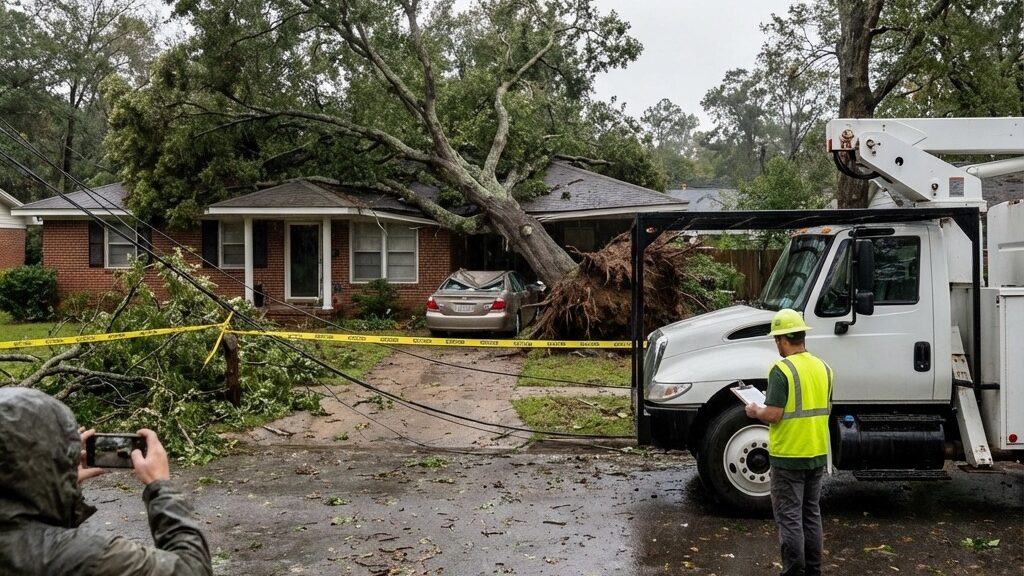
Before you worry about deductibles, property lines, or calling a contractor, your absolute priority must be the physical safety of your family and neighbors. A storm-damaged landscape is a dynamic and dangerous environment.
1. The Invisible Killer: Electrical Hazards
The most critical danger after a tree fall is one you often cannot see. If a tree has dragged down power lines, or even if it is simply resting near a utility pole or transformer, you must assume the entire area is energized.
- The 30 Foot Rule: Stay at least 30 feet away from any downed lines.
- Understand Step Potential: You do not need to touch a wire to be electrocuted. High-voltage electricity can radiate through the ground from the point of contact. As you walk toward the scene, the voltage difference between your two feet can allow fatal current to travel through your body.
- The Action Plan: If lines are down, call Duke Energy immediately to report the outage and the hazard. Do not let anyone, including tree crews, near the tree until the utility company has arrived and confirmed the power is cut.
2. Structural Integrity: To Stay or Go?
If a large tree has impacted your home, do not assume the damage is limited to what you can see.
- Hidden Stress: A large oak or pine can weigh upwards of 10,000 pounds. Even if the branch only punctured the roof, the impact force may have cracked load-bearing walls, shifted the foundation, or compromised the roof trusses.
- Evacuate the Zone: If there is any penetration of the building envelope, evacuate that area of the house immediately. Do not sleep in a room below a tree impact until a professional has assessed the structural stability.
3. The DIY Danger: Why You Must Wait
In the urge to do something, many homeowners grab a chainsaw to clear the driveway. This is a mistake that leads to emergency room visits every year.
- Stored Energy: A fallen tree is rarely just lying flat. It is often twisted, bent, and pinned under extreme tension. This creates stored energy in the wood fibers.
- The Spring Pole Effect: If you cut a branch that is under tension, it can snap back with the force of a catapult and cause severe blunt-force trauma. Professional arborists are trained to identify these pressure points and release them safely.
Phase 2: The Legal Maze: Who Is Responsible?
Once everyone is safe, the most pressing question is almost always financial. Who pays for this?
In North Carolina, the laws regarding falling trees are widely misunderstood. Many homeowners assume that if the tree grew in the neighbor’s yard, the neighbor is responsible. However, liability depends entirely on the condition of the tree prior to the fall rather than strictly on property lines.
Scenario A: The Act of God (Healthy Tree)
The Situation: Your neighbor’s large Oak tree was green, vibrant, and appeared healthy. A severe storm, such as a hurricane remnant, microburst, or ice storm, uproots it and it crashes onto your garage. The Verdict: Legally, this is considered an Act of God. Your neighbor could not have predicted the storm or the tree’s failure. Who Pays: You do. You must file a claim with your homeowner’s insurance policy. Your neighbor is generally not liable for damages, nor is their insurance company.
Scenario B: Negligence (The Dead or Dying Tree)
The Situation: The neighbor’s tree has been dead for two years. It has no leaves, the bark is peeling off, and large mushrooms or conks are growing at the base. You may have even asked them to remove it previously. A storm blows it over onto your house. The Verdict: This is no longer an unpredictable event. It is a known hazard. In legal terms, this is negligence. Who Pays: If you can prove the tree was visibly dead and the neighbor knew or should have known about it, their insurance company should be liable for your damages.
- Pro Tip: This is why we recommend sending a certified letter to a neighbor if they have a threatening tree. It establishes “actual notice” which is powerful evidence in a negligence claim.
Scenario C: The Orphan Tree (No Structural Damage)
The Situation: A tree falls from your yard or a neighbor’s yard and lands in the middle of your lawn. It misses the house, the fence, and the driveway. The Verdict: Most standard homeowners insurance policies only cover tree removal if the tree damages a “covered structure” like a house, garage, or shed, or blocks a driveway used for service. Who Pays: You likely will. If the tree didn’t hit anything, insurance usually views the cleanup as a landscaping maintenance issue rather than a claimable event.
Phase 3: Protecting Your Claim: Documentation and Mitigation
Your actions in the first 24 to 48 hours can significantly impact the success and speed of your insurance settlement.
1. Document Everything BEFORE You Clean
Unless the tree is blocking a public road or creating an immediate safety hazard, do not move anything until you have gathered evidence.
- Wide Angles: Take photos that show the tree’s origin and its final resting place.
- Details: Photograph the damage to your property, such as crushed gutters, broken siding, or a ruined deck.
- The Evidence Shot: If you believe the tree was dead as described in Scenario B, get close-up photos of the broken base. Look for rot, insect tunnels, or hollow cavities. Ask your tree service provider to cut a “cookie” or a slice of the trunk showing the decay and set it aside for the adjuster.
2. Your Duty to Mitigate
Most insurance policies have a clause requiring you to mitigate damages. This means you must take reasonable steps to prevent the situation from getting worse.
- Stop the Water: If there is a hole in your roof, rain can ruin your insulation, drywall, and flooring. If you leave the hole open for days waiting for an adjuster, the insurance company may deny coverage for that secondary water damage.
- Emergency Tarping: Call Queen City Tree Service for emergency tarping. We don’t just throw a sheet over the hole. We professionally secure heavy-duty tarps to withstand wind and rain until a roofer can perform permanent repairs. This cost is almost always reimbursable.

Phase 4: The Removal Process: Why Expertise Matters
Removing a fallen tree is not the same as cutting down a standing one. It is a complex rigging puzzle that requires specialized equipment.
Surgical Removal vs. Brute Force
When a tree is resting on a house, you cannot simply cut it into pieces and let them fall. The sudden release of weight can cause the remaining tree structure to shift. This can smash through the roof further or cause the house wall to spring back and collapse.
At Queen City Tree Service, we utilize cranes for these delicate operations.
- The Lift: The crane operator and the climber work in sync. The climber straps the tree section to the crane hook.
- The Cut: As the cut is made, the crane gently lifts the heavy log up and away from the house and places it softly on the ground or directly into a truck.
- Zero Impact: This method prevents further damage to your home and protects your lawn from being torn up by heavy logs being dragged across the grass.
Navigating the Invoice
Insurance adjusters are sticklers for detail. A handwritten receipt that just says “Tree Removal: $3,000” often leads to delays or partial denials. We provide professional and itemized invoices that speak the language of insurance:
- Line Item 1: Removal from Structure. This cost is usually covered under your dwelling coverage or Coverage A and often has no limit other than your policy max.
- Line Item 2: Debris Hauling. The cost to chop up and haul away the tree once it is on the ground. This often has a sub-limit, such as $500 or $1,000 per tree.
By separating these costs, we help you maximize your reimbursement.
Phase 5: Restoration and Looking Forward
Once the immediate crisis is over, it is time to look at the big picture of your landscape.
Stump Grinding and Replanting
The removal process will leave a stump. We recommend grinding this out immediately while the ground is already disturbed. This prevents termite infestations and clears the way for future planting.
The New Edge Effect
When a large tree falls, it changes the wind dynamics for the remaining trees in your yard. Trees that were previously sheltered by the fallen giant are now exposed to new wind loads they haven’t grown accustomed to. We recommend a follow-up inspection of your remaining canopy to prune for stability and ensure no other trees were damaged during the event.
You Don’t Have to Face This Alone
A fallen tree interrupts your life, threatens your largest investment, and creates a mountain of unexpected stress. But you do not have to handle the heavy lifting, the danger, or the insurance headache alone.
Queen City Tree Service is Charlotte’s trusted partner in storm recovery. We bring the heavy equipment, the certified expertise, and the calm professionalism needed to turn a disaster into a managed project.
If you are staring at a tree on your property right now, put your safety first. Call the professionals who know how to handle it.
Queen City Tree Service 24/7 Emergency Response Line: (704) 606-9696 Fully Insured | Certified Arborists | Free Estimates